




Integrating AI into real work
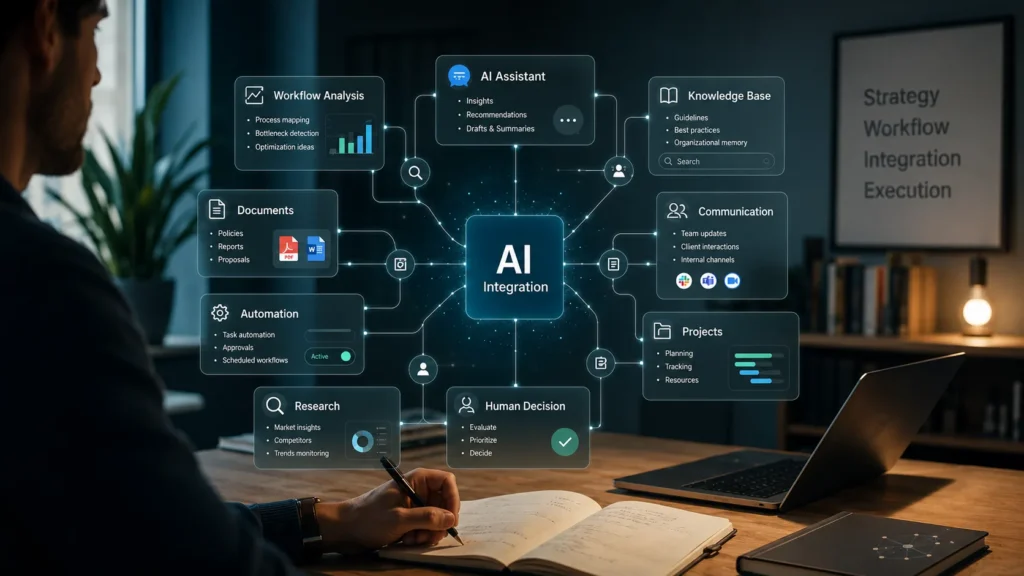
Artificial Intelligence is not only a technology to use. It is a new layer of work, decision-making, communication, research and project development.
Integrate AI into real work, projects and organizations through workflow analysis, system design, prompt engineering and human-centered adoption.
I help individuals, teams and organizations to define where AI can create real value, how it can be integrated into existing workflows, and how to design practical AI-powered systems that remain usable, reliable and human-centered. My approach combines project management, workflow analysis, communication, UX design, research, prompt engineering and AI system design.
The goal is not to use AI everywhere. The goal is to understand where AI is useful, how it can support real work, and how to integrate it in a way that improves clarity, productivity, creativity and decision-making. This is commonly supported by testing and evaluation process. AI integration in European countries is under the EU AI Act Regulation that can include several obligations for which I also offer EU AI Act Compliance Support.
What Is AI Integration?
AI integration is the process of incorporating artificial intelligence into existing business processes, workflows, tools, and decision-making systems. Rather than using AI as a standalone tool, AI integration connects AI capabilities with the way a company already operates, helping teams improve efficiency, reduce repetitive work, enhance decision-making, and create scalable processes that generate measurable business value.
Need support with AI integration?
Need support with AI integration, workflow design or a project?
What AI integration means in practice
Real AI integration begins when AI becomes part of a working process: when it supports specific tasks, connects with existing tools, respects the way people actually work, and helps transform scattered activities into clearer systems.
The transition to real AI integration is from occasional AI use to structured AI workflows, from experimentation to practical integration, from generic prompts to tailored systems. AI integration means identifying where Artificial Intelligence can support a project, a professional activity, a team or an organization.
workflow analysis
task mapping
AI opportunity identification
selection and testing of AI tools
prompt engineering
AI assistants and agents
human-in-the-loop processes
content and communication workflows
research and analysis workflows
document intelligence
decision support systems
automation logic
quality control and evaluation
training and adoption
continuous improvement
How AI can help people work better, communicate better, organize knowledge, reduce repetitive tasks, improve outputs and make better decisions.
For companies and teams
I help companies clarify AI use cases, map workflows and document requirements so that AI processes can be reviewed by internal IT specialists, developers or software providers before implementation.
This is useful for small and medium organizations that want to adopt AI without creating unnecessary technical complexity.
My approach
Before choosing a platform, model, assistant or automation, I analyze the real process: what has to be done, who does it, what information is needed, where the bottlenecks are, what quality standards are required, and what should remain under human control.
1. Workflow before tools
AI should not be added randomly. It should be integrated where it solves a real problem, improves a process or creates measurable value.
2. Human-in-the-loop by design
AI systems should support people, not replace responsibility. Review, approval, supervision and decision points must be designed clearly.
3. Usability and adoption
A system is useful only if people can actually use it. For this reason, I focus on clarity, user experience, workflow fit and practical adoption.
4. Reliability and evaluation
AI outputs need to be tested, reviewed and improved. Good AI integration includes quality control, guardrails, evaluation criteria and fallback logic.
5. System thinking
The value of AI grows when tools, prompts, processes, documents, data, people and decisions are designed as part of the same operating system.
Privacy, confidentiality and data boundaries are considered part of the workflow design, especially when AI is used with internal documents, client information or business-sensitive material.
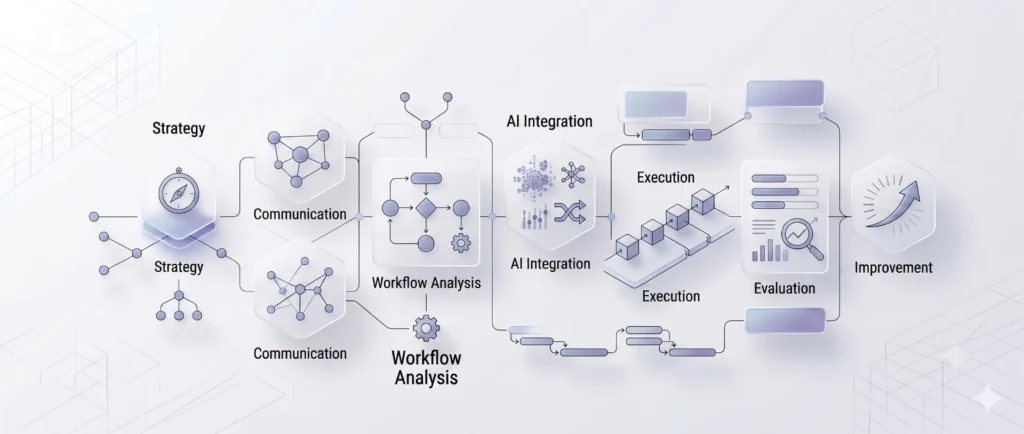
What I can help with
I support AI integration at different levels: from early exploration to complete workflow design, from individual productivity to team systems, from communication workflows to research automation and decision support. This can include AI test and evaluation, AI systems design, and document-based and RAG-oriented workflows for internal knowledge access, research support, content production, decision support and operational assistance.
AI strategy and opportunity analysis
I help clarify where AI can be useful, where it is not necessary, and which use cases should be prioritized.
This can include process analysis, task mapping, tool selection, AI readiness assessment and practical recommendations.
AI workflow design
I design workflows where AI supports real activities: writing, research, planning, communication, analysis, document work, project management, content production, reporting or decision support.
These workflows can be simple, modular or part of a larger operating system.
Prompt engineering and AI instructions
I design prompts, prompt libraries, reusable instructions and structured workflows that make AI outputs more consistent, useful and aligned with the user’s goals.
This includes prompts for content creation, analysis, research, comparison, planning, evaluation, documentation and decision support.
AI assistants, agents and systems
I design AI-powered assistants, agents and systems for specific purposes: document intelligence, research automation, workflow automation, content generation, business analysis, project support and specialized tasks.
The focus is not only on what the system can generate, but on how it works, how it is used, how it is checked and how it fits into a real workflow.
AI adoption and training
AI integration also requires people to understand how to use it. I can support individuals, teams and organizations with practical guidance, training, documentation and adoption workflows.
Possible outputs
Depending on the project, the output can include:
AI opportunity map
workflow analysis
tool comparison
AI use-case definition
prompt or assistant specification
testing and evaluation report
risk and limitation analysis
human-in-the-loop workflow
implementation brief for IT or developers
documentation and usage guidelines
AI integration for Communication, Knowledge, Projects

My background allows me to apply AI integration especially to areas where communication, organization, research and project development are central.
project management
marketing and communication
web content and digital strategy
events and cultural projects
tourism and sustainability projects
research and analysis
reports and documentation
market positioning
business development
knowledge organization
creative and editorial workflows
In these fields, AI can help structure information, generate drafts, compare ideas, analyze material, organize content, support decisions and accelerate execution.
But the strategic value comes from knowing how to connect AI with goals, context, people, processes and quality standards.
AI integration for individuals, teams and organizations
I work with professionals, founders, consultants, small and medium organizations, creative teams, cultural projects, tourism initiatives, sustainability projects, research-based projects and organizations that want to understand how AI can become useful for their goals and in their daily work.
This can include:
- professionals who want to improve their personal workflows
- teams that need shared AI procedures and reusable systems
- organizations, public and private, that want to integrate AI into communication, research or operations
- projects that need AI support for strategy, content, analysis or documentation
- consultants and founders who want to transform their expertise into AI-powered tools or assistants
The objective is to get an AI integration that is tailored, realistic and usable.
AI Workflow Design
AI integration becomes concrete through workflow design. On the AI Workflow Design page, I explain how I design AI-powered workflows, intelligent operating systems, prompt structures, agents, human-in-the-loop processes, evaluation logic and multilingual AI systems.
AI Testing, Evaluation & Research
AI integration should not be based only on enthusiasm or generic claims. Testing, comparison, evaluation and research are essential to understand which tools work, which workflows are reliable, where the risks are, and how AI systems can be improved over time. The AI Testing, Evaluation & Research page focus on AI analysis, tool testing, workflow evaluation, model comparison, prompt testing, quality control, limitations, risks, research.
AI Systems Portfolio
The AI Systems Portfolio page presents the main categories of AI systems I design and develop. These include document intelligence, decision support, research automation, workflow automation, AI-powered content generation, specialized assistants, agents and integrated end-to-end systems. This page will progressively collect examples, structures and use cases.
Working with IT teams and technical constraints
AI integration should not create an isolated layer outside the existing technical environment.
When working with companies, I can collaborate with internal IT specialists, external developers, software providers or technical consultants to make sure that AI workflows are realistic, compatible and properly documented.
My role is not to replace IT. My role is to translate business needs, operational workflows and user requirements into clear AI use cases, workflow structures, prompt systems, evaluation criteria and implementation specifications that technical teams can review, validate and integrate.
This includes attention to:
existing software and platforms
data access and permission limits
privacy and confidentiality requirements
human approval points
documentation and handover
testing before adoption
failure cases and fallback logic
long-term maintainability
The goal is to make AI adoption useful for the organization and manageable for the people responsible for the technical environment.
Why work with me in AI Integration
My work is positioned between strategy and execution.
I am not only interested in AI as a technology. I am interested in how AI changes the way people think, work, communicate, organize knowledge and develop projects.
My experience combines more than 25 years in project management, communication, web projects, media, events, tourism, research and multicultural environments with a present focus on business workflow analysis, AI system design and prompt engineering.
This allows me to connect AI integration with real professional needs.
Any AI – Artificial Intelligence is a probabilistic system based on natural language. I am aware about how an AI works from its foundations because of my education, professional background and personal interests:
- I know what probabilistic and deterministic mean because of my Social Sciences, Communication Sciences and Informatics background.
- I know what a system is because of my Informatics, Web design, Multimedia, Communication Sciences and Tech-oriented background.
- I know what natural language means and how does it work because of my Social Sciences, Communication Sciences, Informatics / Programming and humanistic background. Through the years I have been guenuinely interested, and I have been deeply studying languages, artificial languages (programming) and natural languages from linguistic, semiotic, informatics, artistic, marketing & communication and social/anthropologic points of view. I am confortable with ancient greek and latin, I speak Italian mother tongue, English full working proficiency, Spanish bilingual and I have a working proficiency in Catalan and Portuguese.
Graduated in Communications Sciences with honors, Master in ICT Project Management – Internet and Multimedia Publishing.
Need support with AI integration?
Need AI integration for a real workflow or service? Let’s talk.
A practical, scalable and human-centered way to use AI
Good AI integration should make work clearer, not more confusing.
It should help people understand what they are doing, improve the quality of their outputs, reduce unnecessary friction, and create systems that can evolve.
Artificial Intelligence becomes truly useful when it is connected with human goals, real workflows and meaningful projects.
AI can support your work, your team, your organization or your project.
Contact me to discuss an AI workflow, evaluation or integration project.
FAQ
What is AI integration?
AI integration is the implementation of AI technologies within existing business operations, systems, and workflows to improve performance and outcomes.
When does a company need AI integration?
A company typically needs AI integration when teams spend significant time on repetitive tasks, struggle with information management, or want to improve outcomes, productivity, decision-making, and scalability.
What is the difference between AI automation and AI integration?
AI automation focuses on automating specific tasks. AI integration is broader and involves embedding AI into workflows, systems, and organizational processes so that AI becomes part of how the business operates. Human cantered AI Integration focus on human supervision, control and decisions, making explicit AI roles and irreplaceable human roles.
How much does AI integration cost?
The cost varies depending on the complexity of the project, the existing systems involved, and the level of customization required. Small initiatives can often start with limited investments and scale over time.
AI integration, AI workflow design, AI systems design, AI automation, AI-powered workflows, AI adoption, prompt engineering, AI Consulting, human-in-the-loop AI
AI tools for business, AI systems for organizations, AI project consulting, AI for communication, AI for research, AI for project management
Related pages

AI Workflow Design
AI Systems Design, Workflow Strategy and Usability. I design AI workflows for integration, testing, and evaluation. My work connects AI systems, prompt engineering, and human-in-the-loop automation to create practical, scalable, and usable solutions for real projects and organizations ...

AI Testing, Evaluation & Research
AI systems need review as well as implementation. I work on AI testing, evaluation and research to support comparison, quality control, risk awareness, usability and informed decisions across tools, workflows and real-world use cases ...

AI Systems Portfolio
AI system design and development: deterministic systems, scalable systems, integration ready. A selecion of AI Systems that presents the main categories of systems I have been designing and developing, with case study and real use examples ...
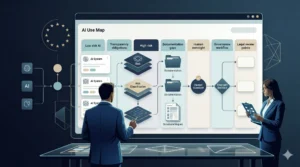
EU AI Act Compliance
Practical support to map AI use, identify obligations, classify risk, and prepare the documentation needed for responsible AI Integrartion and deployment under the EU AI Act ...
Project Management
Project management for communication, business development and AI integration. My approach connects strategic planning, communication, workflow analysis and AI integration. I help individuals, teams and organizations throughout all the phases of project development ...

Communications and Human Stories
Communications and storytelling, strategic communication, meaningful narratives. Communication is not only about visibility. It is about making a project understandable, memorable and alive. I help individuals, organizations, teams and projects communicate their identity, value ...