




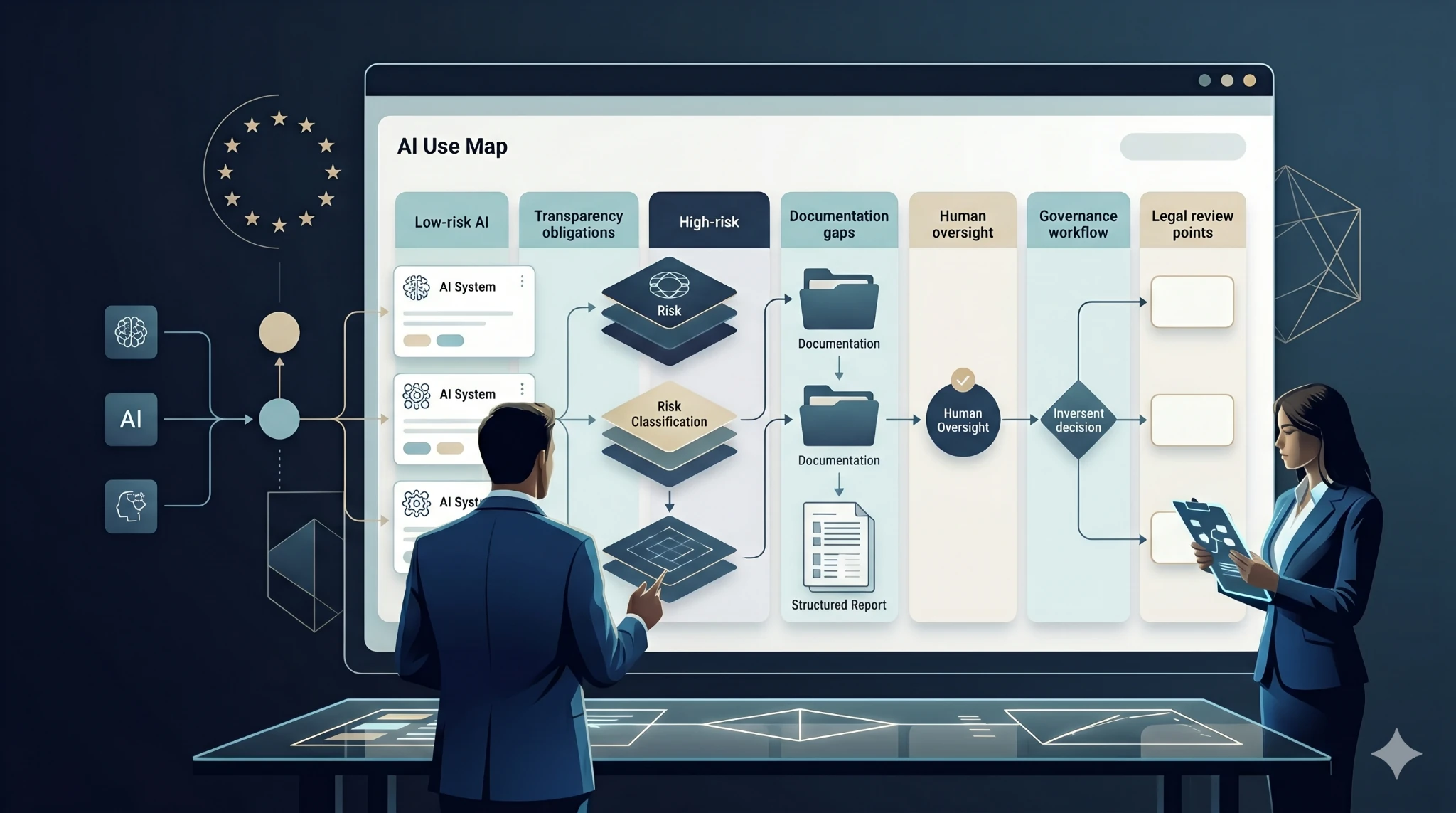
Practical support to map AI use, identify obligations, classify risks and risk categories, and prepare the documentation needed for responsible AI deployment under the EU AI Act.
Understanding AI obligations before they become a problem
Artificial intelligence is becoming part of everyday business operations: content creation, research, automation, customer support, decision support, data analysis, and internal workflows. With the European Union AI Act, organizations using AI will increasingly need to understand not only which tools they use, but also what responsibilities, risks, documentation, and transparency measures may apply.
The challenge is that AI compliance is not only a legal question. It is also an operational one. Before you can know what obligations apply, you need to understand where AI is being used, how it affects decisions or outputs, who is responsible for it, what data it processes, and whether human oversight is properly defined.
The Act follows a risk-based structure, with obligations varying depending on whether an AI use case is prohibited, high-risk, transparency-related, general-purpose AI-related, or lower-risk. The Commission confirms that prohibited practices and AI literacy obligations already applied from 2 February 2025, while further obligations apply progressively through 2026 and 2027 (Regulation (EU) 2024/1689 of the European Parliament and of the Council of 13 June 2024 laying down harmonised rules on artificial intelligence — Artificial Intelligence Act).
I help organizations map their AI systems, classify their use cases, identify potential obligations, and prepare structured documentation for responsible AI integration and AI deployment. This service is designed for teams that use or plan to use AI in workflows, content production, decision support, automation, research, customer interaction, or internal operations.
Need support with EU AI Act Compliance?
Need support with EU AI Act Compliance and AI integration?
Why this matters
Many organizations already use AI without having a clear internal map of where, how, and why it is being used. AI may appear in many AI workflows such as: marketing processes, document analysis, client communication, workflow automation, research, image generation, decision support, or third-party software platforms.
Without proper clarity, this can create practical risks:
You may not know whether risk category an AI system is: low-risk, transparency-related, high-risk, or potentially prohibited.
You may not know whether your organization is acting as a provider, deployer, or simply as a user of an AI tool.
You may lack documentation explaining how the AI system works, what it is used for, what its limits are, and who supervises it.
You may not have clear internal rules for human oversight, data use, AI-generated content, or responsibility for outputs.
You may be unprepared when clients, partners, regulators, or internal stakeholders ask how AI is being used.
The goal is not to create unnecessary bureaucracy. The goal is to make AI use visible, understandable, documented, and governable, also realizing, when needed, AI testing, evaluation and research.
A structured AI Act readiness process helps organizations move from informal AI experimentation to responsible AI implementation. It gives you a clearer view of your obligations, your risks, your documentation gaps, and the practical steps needed to use AI with more confidence.
What I help you clarify
- What AI systems or tools you are using
- What role your organization plays
- Whether your use cases may fall into regulated categories
- What documentation is missing
- What transparency measures may be needed
- What internal policies should be created
- What should be reviewed by a legal professional
Services
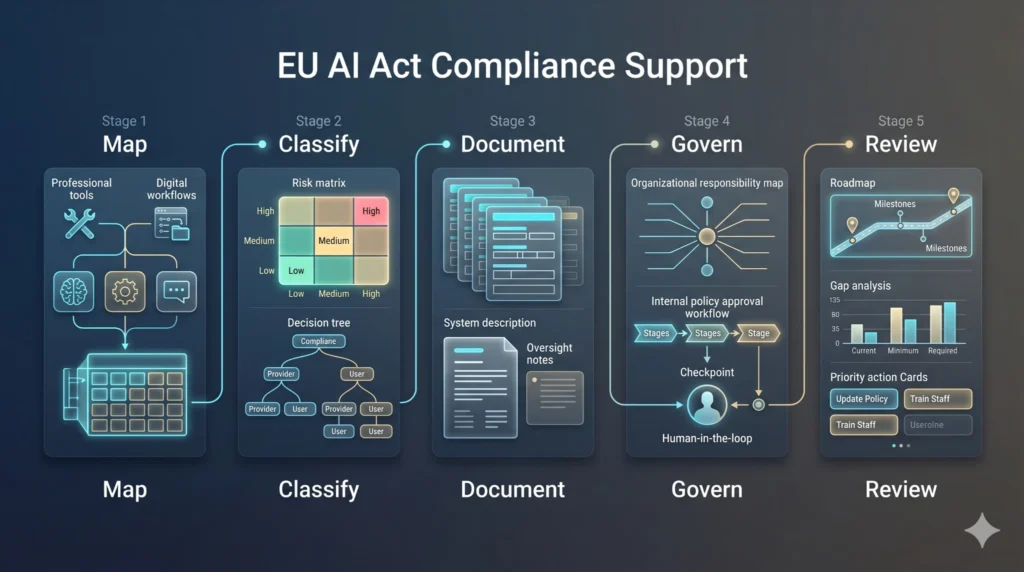
1. AI Use Case Mapping
Purpose: identify where AI is actually used in the organization.
Mapping of current or planned AI tools, workflows, automations, content-generation processes, decision-support systems, and data-processing activities.
Deliverables:
AI use inventory
Workflow map
List of AI tools and system purposes
Internal vs. external use distinction
Human involvement map
2. AI Act Role & Risk Classification
Purpose: understand whether the organization is a provider, deployer, importer, distributor, product manufacturer, or user of AI systems.
Preliminary classification of AI use cases according to the EU AI Act risk-based framework, including identification of potentially prohibited, high-risk, transparency-related, or low-risk uses.
Deliverables:
AI risk classification matrix
Role identification: provider/deployer/other
Risk level summary
Priority actions list
3. Documentation Preparation
Support in preparing structured documentation for AI workflows, including system purpose, inputs, outputs, human oversight, limitations, risks, data sources, decision points, and operational responsibilities.
Deliverables:
AI system description
Workflow documentation
Human oversight notes
Risk and limitation register
Internal AI usage policy
Transparency statement draft
AI-generated content disclosure logic
4. AI Governance & Internal Policy Support
Purpose: help companies become organized before obligations become urgent.
Design of lightweight internal governance processes for responsible AI use, including approval workflows, review procedures, user responsibilities, AI literacy actions, and documentation routines.
The AI Act already includes AI literacy obligations from 2 February 2025, meaning organizations using AI should pay attention not only to tools, but also to people, training, and responsible internal use.
Deliverables:
Internal AI policy
AI usage guidelines
Staff AI literacy checklist
Review and approval workflow
Governance responsibility map
5. Compliance Readiness Review
Purpose: practical gap analysis.
A structured review of current AI workflows against the main EU AI Act readiness areas, producing a clear action plan for documentation, governance, transparency, and risk management.
Deliverables:
AI Act readiness report
Gap analysis
Compliance preparation roadmap
Urgent / medium / low priority actions
Recommendations for legal review where needed
Who this service is for
Small-medium businesses using AI tools
Consultants and agencies using AI in client work
Organizations introducing AI workflows
Teams using AI for content, research, automation, decision support, or customer communication
Companies unsure whether their AI use is low-risk, transparency-related, or potentially high-risk
Need support with EU AI Act Compliance?
Need support with EU AI Act Compliance for AI integration?
Important note
This service provides operational, strategic, and documentation support for AI Act readiness. It does not replace formal legal advice. When legal interpretation, regulatory filing, or high-risk classification confirmation is required, the work can be coordinated with legal professionals.
Related pages
AI Integration
AI integration for projects, workflows and human-centered systems. AI is not only a technology to use. It is a new layer of work, decision-making, communication, research and project development. Integrate Artificial Intelligence into real work, projects and organizations through workflow analysis, system design ...

AI Workflow Design
AI Systems Design, Workflow Strategy and Usability. I design AI workflows for integration, testing, and evaluation. My work connects AI systems, prompt engineering, and human-in-the-loop automation to create practical, scalable, and usable solutions for real projects and organizations ...

AI Testing, Evaluation & Research
AI systems need review as well as implementation. I work on AI testing, evaluation and research to support comparison, quality control, risk awareness, usability and informed decisions across tools, workflows and real-world use cases ...

AI Systems Portfolio
AI system design and development: deterministic systems, scalable systems, integration ready. A selecion of AI Systems that presents the main categories of systems I have been designing and developing, with case study and real use examples ...

Project Management
Project management for communication, business development and AI integration. My approach connects strategic planning, communication, workflow analysis and AI integration. I help individuals, teams and organizations throughout all the phases of project development ...

Communications and Human Stories
Communications and storytelling, strategic communication, meaningful narratives. Communication is not only about visibility. It is about making a project understandable, memorable and alive. I help individuals, organizations, teams and projects communicate their identity, value ...