


Decision Support
Decision Support system
System value
PROBLEM
Strategic decisions are often slowed down by scattered information, unclear constraints, and discussions that mix facts with assumptions. Teams may compare too few options, overlook risks, or spend too much time structuring the decision before they can even evaluate it properly.
SOLUTION
This system turns a complex business decision into a clear decision framework. It organizes what is known, shows what is missing, outlines realistic strategic options, and compares those options in a structured way so stakeholders can discuss the decision with more clarity and less ambiguity.
VALUE
Saves time by:
reducing the manual work needed to organize scenario information, structure options, and prepare comparison material for decision meetings.
Improves decisions by:
forcing a clearer view of the available strategic paths, their feasibility, and the trade-offs between them.
Reduces risk by:
making missing data, hidden assumptions, contradictions, and major uncertainties visible before a decision is pushed forward.
Automates:
the repetitive part of strategic analysis: organizing facts, framing options, comparing paths, and structuring risks and uncertainty.
BEFORE → AFTER
Before:
A team discusses a strategic move through fragmented notes, partial data, and subjective opinions. The result is often a long conversation with limited structure and weak comparison between alternatives.
After:
The same decision is presented as a clear set of options, each with its logic, key constraints, risks, and uncertainty. Stakeholders can compare paths faster and discuss the decision at the right level.
IMPACT SUMMARY
Can save roughly 1–4 hours per decision case in initial analysis and preparation work
Can shorten decision discussions by giving teams a ready-made comparison structure
Can reduce overlooked issues by making constraints, risks, and missing information explicit
Simplifies workflow by replacing ad hoc analysis with a repeatable decision format
System explanation
SYSTEM NAME
Strategic Decision Analysis System
WHAT IT DOES
Provides a structured analysis of complex business decisions, helping stakeholders clearly understand available strategic options, constraints, risks, and uncertainties before making a choice.
HOW IT WORKS
The system takes a business scenario and organizes the information into key elements: confirmed facts, missing data, constraints, and possible strategic paths. It then builds multiple distinct decision options and evaluates each one in terms of feasibility, risks, and uncertainty—without recommending a specific course of action. A final internal review ensures that the analysis is consistent, evidence-based, and free from unsupported assumptions.
OUTPUT MEANING
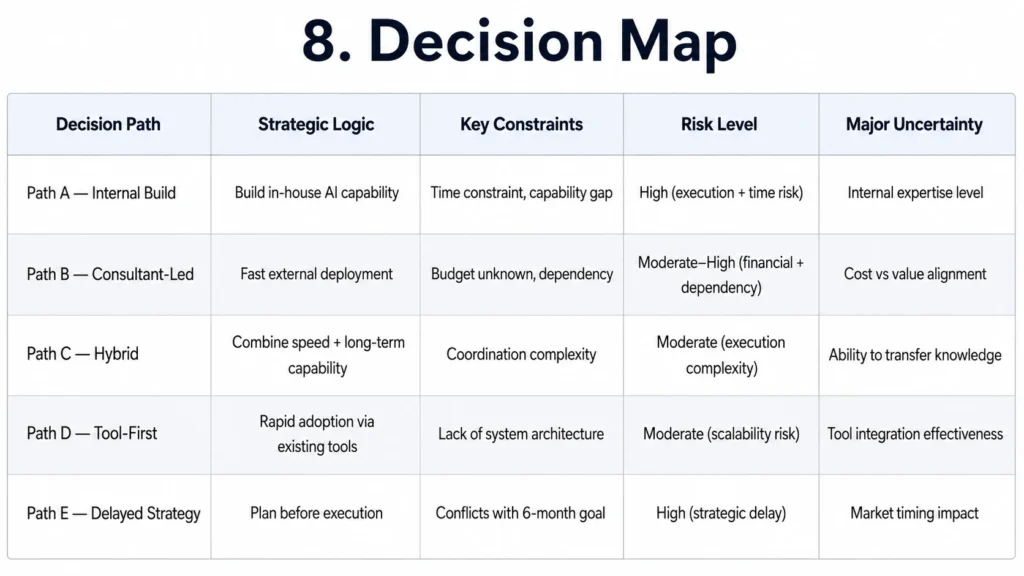
The output is a decision map, not a recommendation. It shows:
– what options are realistically available
– what risks are associated with each option
– what uncertainties could affect outcomes
This allows decision-makers to compare strategies side by side and choose based on their priorities, risk tolerance, and available resources.
WHAT IT DOES NOT DO
Does not make decisions or provide recommendations unless explicitly requested.
Does not fill in missing data or speculate beyond the provided information.
Does not guarantee that all possible strategies are covered if input data is incomplete.
LIMITATIONS
The quality of the analysis depends directly on the completeness and accuracy of the input information.
If key inputs (e.g., financial capacity, market data, or operational constraints) are missing, feasibility assessments may remain uncertain.
The system highlights uncertainty but cannot reduce it without additional data.
HOW TO USE IT
Use it at the early and mid stages of strategic decision-making to structure thinking before committing to a direction.
Provide as much relevant information as possible (scenario, capabilities, constraints, timeline) to improve reliability.
Use the output to facilitate discussions, compare options, and identify where more data is needed before making a final decision.
Input example
INPUT:
{{
insert the minimal structured input here (Input description below):
Scenario description
”
A small-medium company executive has to decide if, how, and how much to invest in AI based tools and workflows, and if to hire a worker for this or go to a consultant.
”
Company profile
”
Entertainment company with some directly managed cultural and entertainment locations (music bars, concert halls, theatres, ets.), a rich artist portfolio contact lists, intensive use of social networks in communications, fast and quickly changing workflows and timings during everyday business management actions and deployment.
”
Time horizon for the decision
”
the AI usage across company activities has to start quickly into a well planned integration strategy that in 6 months should give already a high level initial Company AI Tools System
”
}}
The analysis may include the following information.
Scenario description
Company profile
Financial capacity or investment limits
Existing expertise or capabilities
Competitive landscape
Regulatory environment
Market growth indicators
Operational constraints
Time horizon for the decision
Decision Analysis Report
1. Scenario Summary
A small–medium entertainment company must decide whether, how, and to what extent to invest in AI tools and workflows, and whether to hire internally or rely on external consulting, with the objective of achieving a functional AI system within 6 months.
2. Known Facts
The company operates in the entertainment sector (music bars, concert halls, theatres).
It manages:
Physical venues
Artist portfolios and contact networks
It relies heavily on:
Social media communication
Fast-changing, operational workflows
The company aims to:
Quickly start AI adoption
Reach a high-level operational AI system within 6 months
The decision includes:
Whether to invest in AI tools
Whether to hire internally or use a consultant
3. Missing Information
Critical missing inputs affecting analytical reliability:
Financial capacity / budget constraints
Current internal digital/AI capabilities
Team size and structure
Current tool stack (CRM, marketing tools, ticketing, etc.)
Competitive landscape (AI adoption by competitors)
Regulatory constraints (data handling, AI usage in marketing, etc.)
Strategic priority (efficiency vs growth vs differentiation)
→ These gaps directly impact feasibility assessment and risk evaluation.
4. Key Constraints
Time Constraint
6-month horizon for a “high-level AI system”
→ Strong pressure on speed of execution (input fact)
Operational Complexity
Fast-changing workflows and real-time operations
→ Limits slow or rigid implementations (input fact)
Structural Uncertainty
Unknown internal capabilities and budget
→ Limits feasibility certainty (missing input)
Organizational Adaptability
AI integration must align with dynamic daily operations
→ Risk of disruption if poorly integrated (input fact)
Decision Scope Complexity
Simultaneous decisions:
investment level
implementation model (internal vs external)
5. Possible Decision Paths
Path A — Internal Capability Build (Hire + Build System Internally)
Strategic Logic
Develop AI capabilities by hiring dedicated personnel and building internal workflows.
Feasibility Assessment
Financial: uncertain (budget unknown)
Capabilities: likely low initially (missing input)
Operational: moderate friction due to learning curve
Time horizon: high risk vs 6-month goal
→ Feasibility: uncertain to low, given time constraint and unknown capabilities
Path B — External Consultant-Led Implementation
Strategic Logic
Engage AI consultant(s) to design and deploy initial AI systems rapidly.
Feasibility Assessment
Financial: uncertain (consulting cost unknown)
Capabilities: outsourced
Operational: higher alignment speed
Time horizon: aligned with 6-month requirement
→ Feasibility: moderate to high, conditional on budget
Path C — Hybrid Model (Consultant + Internal Gradual Build)
Strategic Logic
Use consultants for initial deployment while gradually building internal capability.
Feasibility Assessment
Financial: moderate to high requirement
Capabilities: progressive internalization
Operational: balanced adaptation
Time horizon: aligned if well structured
→ Feasibility: moderate, but depends on coordination capacity
Path D — Tool-First Approach (No Dedicated Hire Initially)
Strategic Logic
Adopt existing AI tools (SaaS, automation platforms) without structural investment.
Feasibility Assessment
Financial: likely lower entry cost
Capabilities: low requirement
Operational: high adaptability
Time horizon: fastest to deploy
→ Feasibility: high, but limited system depth
Path E — Delayed Structured Strategy (Planning First, Execution Later)
Strategic Logic
Delay implementation to design a comprehensive long-term AI strategy.
Feasibility Assessment
Financial: controlled
Capabilities: developed slowly
Operational: low disruption initially
Time horizon: conflicts with 6-month requirement
→ Feasibility: low relative to stated objective
6. Risks per Path
Path A — Internal Build
Financial risk: hiring + ramp-up cost (missing budget input)
Operational risk: slow onboarding vs fast workflows (input fact)
Strategic risk: failure to deliver within 6 months (time constraint)
Execution risk: capability gap (missing expertise input)
Path B — Consultant-Led
Financial risk: potentially high consulting cost (missing input)
Strategic risk: dependency on external expertise
Operational risk: misalignment with internal workflows
Execution risk: knowledge not retained internally
Path C — Hybrid
Financial risk: combined cost (consultant + internal)
Operational risk: coordination complexity
Strategic risk: unclear ownership of system
Execution risk: transition failure from external to internal
Path D — Tool-First
Strategic risk: fragmented AI system (no architecture)
Operational risk: tool overload or poor integration
Execution risk: limited scalability
Financial risk: cumulative SaaS costs over time
Path E — Delayed Strategy
Strategic risk: missed competitive advantage
Operational risk: inefficiency persists
Market risk: competitors adopt AI faster (missing competitor data)
Time risk: failure to meet internal urgency
7. Uncertainty Analysis
Data Uncertainty
No information on budget or internal capabilities
→ Directly impacts feasibility of Paths A, B, C
Market Uncertainty
Unknown level of AI adoption in entertainment competitors
→ Affects urgency and strategic positioning
Execution Uncertainty
Unknown internal readiness for workflow change
→ Critical for all paths, especially A and C
Technology Uncertainty
No clarity on which AI use cases are prioritized
→ Impacts system design effectiveness
Organizational Uncertainty
Unknown decision-making speed and leadership alignment
→ Impacts 6-month execution feasibility
9. Analysis Review
Facts vs assumptions:
All confirmed facts were explicitly separated from missing inputs. No assumptions were treated as facts.
Decision path validity:
Each path logically derives from:
time constraint (6 months)
decision scope (AI + hiring vs consulting)
operational context (fast workflows)
Uncertainties explicitly stated:
Key uncertainties (budget, capabilities, competition) clearly identified and linked to missing inputs.
Contradictions identified:
A structural tension exists between:
need for fast implementation (6 months)
unknown internal capabilities and resources
→ This directly impacts feasibility of internal-heavy paths.
Recommendations:
None provided, in compliance with constraints.

AI Systems Portfolio

AI Integration

AI Workflow Design