


Research Automation
Research Automation system
System value
PROBLEM
Research and analysis today are often:
unstructured and inconsistent
dependent on individual expertise
prone to missing critical information
difficult to verify or trace
slow when decisions require multiple perspectives
This leads to wasted time, unreliable conclusions, and higher decision risk.
SOLUTION
This system provides a structured way to conduct research from start to finish.
It breaks down complex questions, explores multiple perspectives, gathers and organizes evidence, and produces clear, decision-ready conclusions — all while showing where information comes from and how reliable it is.
VALUE
Saves time by:
reducing research and analysis effort by up to 30–60%, eliminating rework and manual structuring
Improves decisions by:
ensuring all relevant angles are explored and clearly compared before conclusions are made
Reduces risk by:
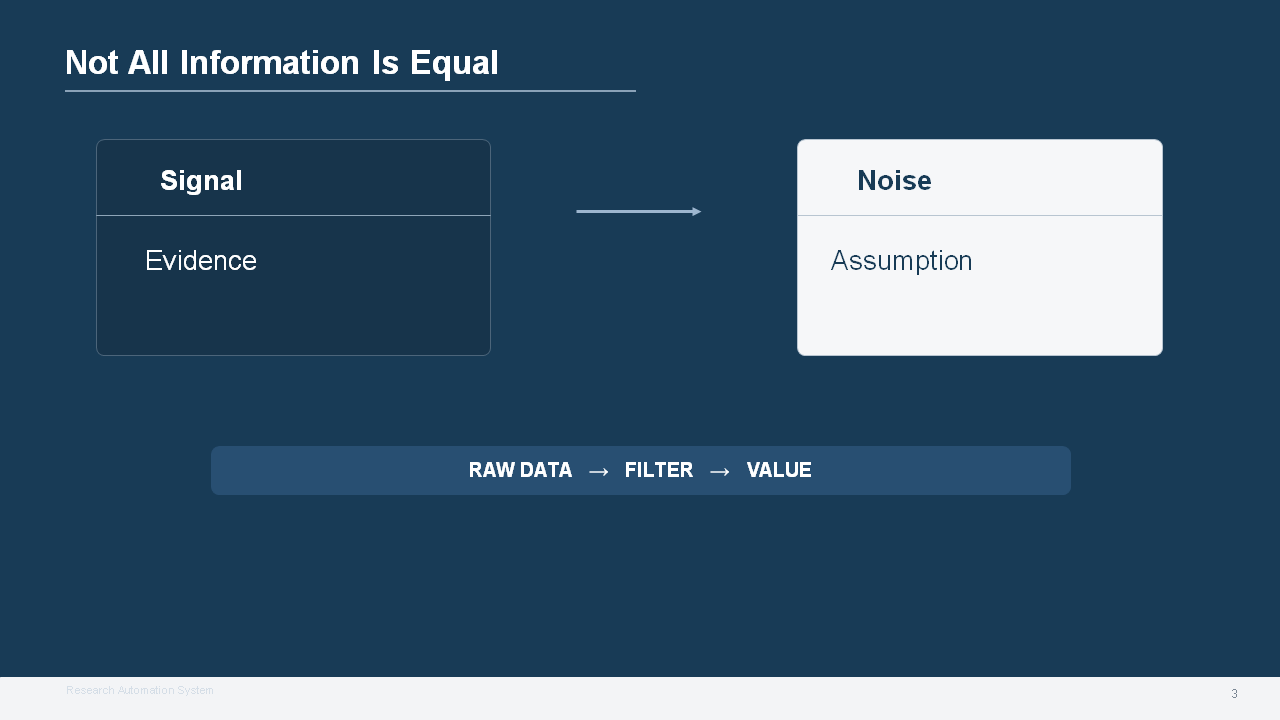
making every piece of information traceable and separating facts from assumptions
Automates:
the full research workflow — from framing the problem to delivering a structured conclusion
BEFORE → AFTER
Before:
Research takes hours or days, often incomplete, hard to verify, and dependent on individual judgment
After:
Research becomes structured, faster, and reliable, with clear evidence and actionable conclusions
IMPACT SUMMARY
30–60% reduction in research time
Faster decision cycles (up to 50% improvement)
Significant reduction in errors and missed insights
Clear, auditable research outputs





System explanation
SYSTEM NAME
Research Automation System
WHAT IT DOES
This system turns a research request into a structured analysis workflow. It helps define the question, explore it through multiple research paths, collect information from selected sources, separate evidence from interpretation, compare competing findings, and produce a conclusion that is useful for decisions while making uncertainty visible.
HOW IT WORKS
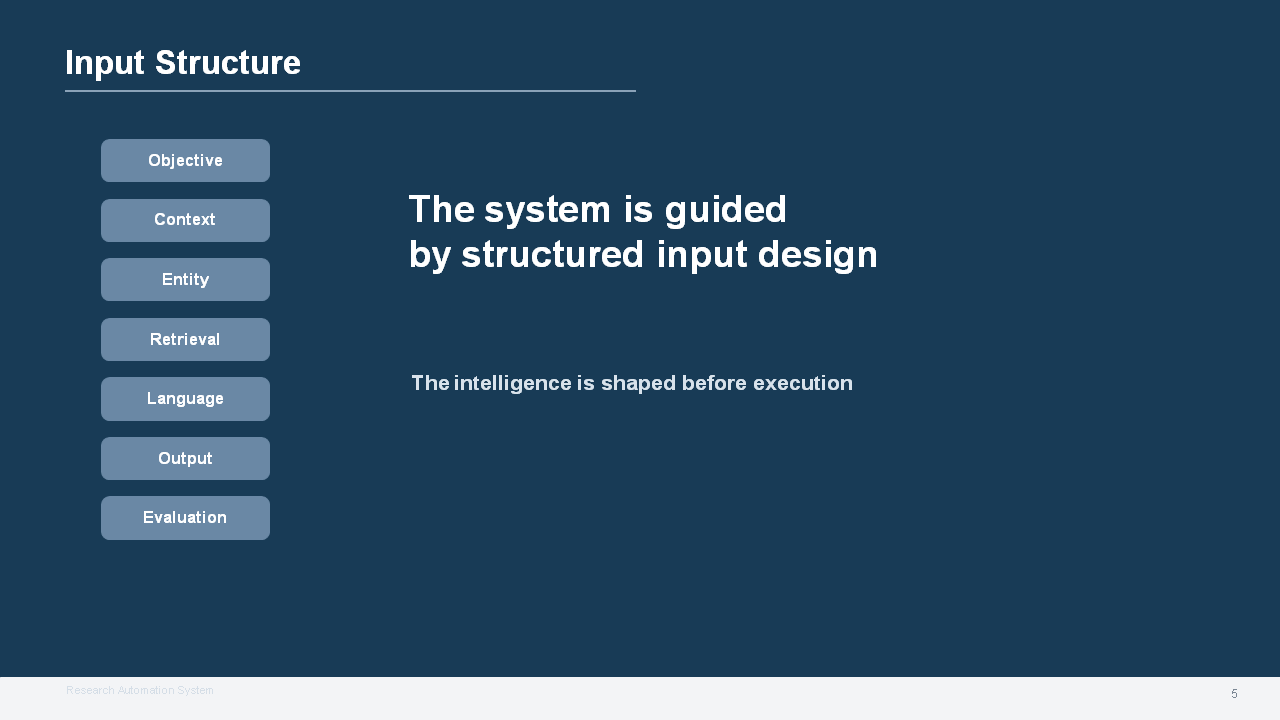
It starts by clarifying the research objective, scope, and success criteria. It then breaks the topic into key questions and designs multiple investigation paths so the analysis does not depend on a single line of reasoning. After that, it retrieves information only from the source types selected for the project, such as internal knowledge, provided documents, or web and database sources. The system then organizes what was found into evidence, turns that evidence into findings, compares the findings across paths, and produces a final conclusion with confidence limits and next-step guidance.
OUTPUT MEANING
The outputs show more than just an answer. They show how the research was framed, which paths were explored, what evidence supports each finding, where sources came from, where uncertainty remains, and whether the conclusion is strong, conditional, or not reliable enough yet. This supports decisions that require structured analysis, comparison of perspectives, source-aware review, and explicit understanding of what is known versus what is still uncertain.
WHAT IT DOES NOT DO
It does not replace expert judgment. It does not guarantee that a conclusion is correct just because it is well structured. It does not hide uncertainty or merge different source types into one untraceable result. It does not force agreement between conflicting findings. It is not a generic chat system designed to improvise answers without evidence discipline.
LIMITATIONS
Its quality depends on the quality, completeness, and relevance of the selected sources. If the retrieval mode is narrow, the result will also be narrow. If provided documents are incomplete, the analysis will reflect those gaps. If different research paths produce conflicting results, the system may end with conditional or inconclusive outputs rather than a clean answer. It also depends on correct research framing at the start: a weak brief or unclear scope can reduce the usefulness of the entire workflow.
HOW TO USE IT
Use it when you need disciplined research rather than a quick answer. Start by defining a clear objective, scope, and desired output. Choose retrieval modes deliberately based on the use case, and use multiple source types when broader coverage is needed. Review not only the final conclusion, but also the evidence, findings, source attribution, and uncertainty sections before acting. Treat the system as a structured research support tool that improves clarity, traceability, and decision readiness, especially when human review remains part of the workflow.

AI Systems Portfolio

AI Integration

AI Workflow Design