





AI test, evaluation and research for practical AI integration and Workflow Design

AI testing, evaluation and research for tools, workflows, prompts and AI systems.
Practical analysis of reliability, usability, limits and real-world value
Before a real AI integration can take place, before an AI tool, workflow, prompt, model or system becomes part of real work, it should be tested, compared and evaluated. I analyze Artificial Intelligence tools, workflows and systems to understand what works, what not, where the limits are, and how AI can create real value in practical contexts.
What Is AI Test, Evaluation & Research?
AI test, evaluation, and research is the systematic process of assessing AI systems, workflows, prompts, agents, and automation solutions. It helps organizations understand performance, reliability, limitations, risks, and opportunities for improvement. Through structured testing and analysis, businesses can make informed decisions before deploying AI systems at scale.
From experimentation to reliable use
Trying AI tools is easy. Understanding their real usefulness is more difficult.
A tool can look powerful in a demo and still be weak in daily work.
A prompt can work once and fail when the context changes.
A model can generate fluent answers and still produce errors, omissions or unreliable conclusions.
An automation can save time in one phase and create problems in another.
AI Testing, Evaluation & Research helps move from experimentation to more reliable, documented and usable AI adoption.
Need support with AI testing and evaluation?
Need support with AI testing, evaluation and AI integration?
What I test and analyze

I can support testing and research on:
AI tools and platforms
AI models and assistants
prompt structures and prompt libraries
AI-powered workflows
research and analysis systems
document intelligence workflows
content generation and refinement workflows
agents and automation logic
human-in-the-loop processes
output quality and consistency
usability and adoption
limitations, risks and failure points
The focus is not abstract testing. The focus is how AI performs in real tasks, real workflows and real professional contexts.
AI evaluation should include privacy and data-risk checks, especially when workflows involve internal documents, client data or sensitive operational information.
AI integration in European countries is under the EU AI Act Regulation that can include several obligations for which I also offer EU AI Act Compliance Support.
For RAG-oriented or document-based knowledge assistant workflows, evaluation can include source accuracy, citation quality, freshness, privacy boundaries and hallucination risk.
Evaluation criteria
Good AI evaluation is not only technical. It also needs to consider usefulness, clarity, reliability, workflow fit and human control.
I analyze AI systems through questions such as:
Does this tool solve a real problem?
Is the output useful, consistent and reviewable?
Where does the system fail?
What needs human supervision?
Can the workflow be repeated?
Is it usable for the people who need it?
Does it create enough value compared to the effort required?
What risks, limits or quality problems need to be managed?
This makes AI testing useful for decisions, not only for experimentation.
For organizations, AI evaluation should also support technical decision-making. This means clarifying which tools are suitable, what data they require, what risks they introduce, what human checks are needed, and whether the workflow can be maintained inside the existing technical and operational environment.
Research, comparison and decision support
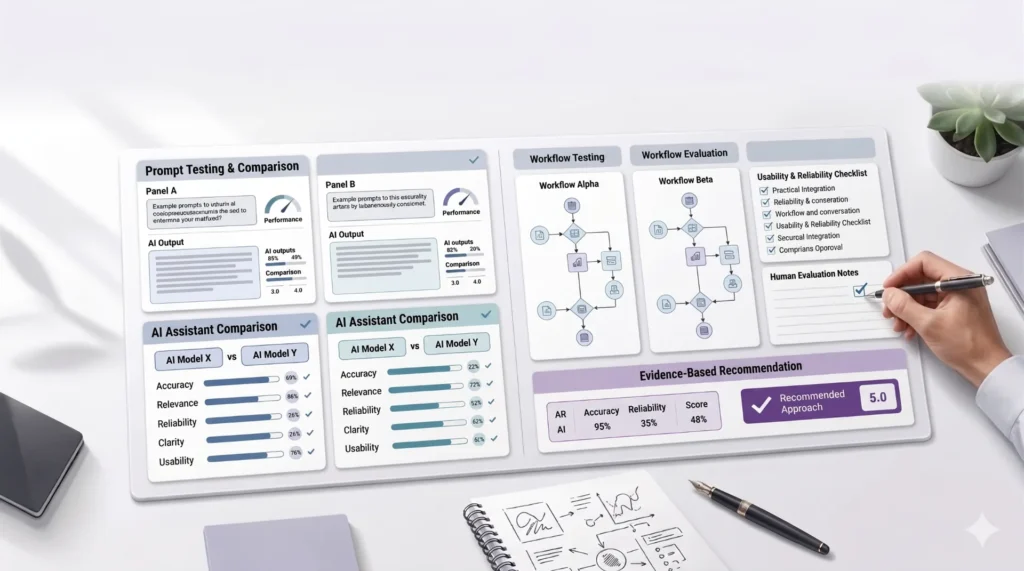
AI Test & Research can support decisions before choosing a tool, designing a workflow or integrating an AI system.
This can include:
tool comparison
model comparison
prompt testing
workflow evaluation
AI use case analysis
quality control
risk and limitation analysis
research on AI tools and trends
evaluation of existing AI solutions
recommendations for implementation
documentation of findings
The output can be a short analysis, a comparison table, a structured report, a recommendation document or the basis for a future AI integration project.
For companies and small teams
I help companies clarify AI use cases, map workflows and document requirements so that AI processes can be reviewed by internal IT specialists, developers or software providers before implementation.
This is useful for small and medium organizations that want to adopt AI without creating unnecessary technical complexity.
Testing and Evaluation for AI Integration and AI Workflow Design
AI Integration explains the general approach: integrating AI into real work, projects and organizations through workflow analysis, system design, prompt engineering and human-centered adoption.
AI Workflow Design focuses on designing AI-powered workflows, agents, human-in-the-loop processes, evaluation logic, QA and guardrails.
AI Systems Portfolio presents categories of AI systems and real AI systems examples: document intelligence, decision support, research automation, workflow automation, AI-powered content generation, specialized agents and integrated systems.
AI Testing, Evaluation & Research is the validation layer: testing, comparing and analyzing what is ready, what is useful, what is risky, and what needs improvement.
For whom
This service is useful for professionals, consultants, teams and organizations that want to use AI.
It is especially useful when you need to:
choose between different AI tools
test prompts before using them repeatedly
evaluate an AI assistant or automation
compare models or platforms
understand whether an AI workflow is reliable
identify risks, limits and failure points
prepare a more solid AI integration strategy
turn experimentation into practical decisions
Need support with AI testing and evaluation?
Need AI testing and evaluation for AI integration? Let’s talk.
Practical AI Integration
My work combines research, workflow analysis, usability, communication, project management, prompt engineering and AI systems thinking.
The objective is to understand how AI can become genuinely useful, reliable, usable and valuable in real-world work.
Contact me to discuss an AI workflow, evaluation or integration project.
FAQ
What is AI evaluation?
AI evaluation is the process of measuring how effectively an AI system performs against defined objectives, requirements, and quality standards.
Why is AI testing important?
Testing helps identify weaknesses, inconsistencies, risks, and failure points before AI solutions are deployed in real-world environments.
What is included in AI research services?
AI research may include technology assessment, market analysis, solution comparison, feasibility studies, prompt evaluation, workflow analysis, and implementation recommendations.
How often should AI systems be evaluated?
AI systems should be evaluated regularly, especially after updates, workflow changes, model changes, or when business requirements evolve.
AI test, AI evaluation, AI research, AI tools testing, AI workflow evaluation, AI, model comparison, prompt testing, AI quality control, AI limitations
AI risk analysis, AI usability testing, AI system evaluation, AI tool comparison, AI implementation research
Related pages
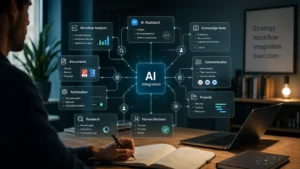
AI Integration
AI integration for projects, workflows and human-centered systems. AI is not only a technology to use. It is a new layer of work, decision-making, communication, research and project development. Integrate Artificial Intelligence into real work, projects and organizations through workflow analysis, system design ...

AI Workflow Design
AI Systems Design, Workflow Strategy and Usability. I design AI workflows for integration, testing, and evaluation. My work connects AI systems, prompt engineering, and human-in-the-loop automation to create practical, scalable, and usable solutions for real projects and organizations ...

AI Systems Portfolio
AI system design and development: deterministic systems, scalable systems, integration ready. A selecion of AI Systems that presents the main categories of systems I have been designing and developing, with case study and real use examples ...
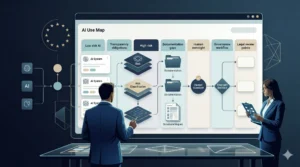
EU AI Act Compliance
Practical support to map AI use, identify obligations, classify risk, and prepare the documentation needed for responsible AI Integrartion and deployment under the EU AI Act ...
Project Management
Project management for communication, business development and AI integration. My approach connects strategic planning, communication, workflow analysis and AI integration. I help individuals, teams and organizations throughout all the phases of project development ...

Communications and Human Stories
Communications and storytelling, strategic communication, meaningful narratives. Communication is not only about visibility. It is about making a project understandable, memorable and alive. I help individuals, organizations, teams and projects communicate their identity, value ...